

If your custom character constantly changes personalities, brings back old and forgotten relationships, or unexpectedly goes off character in NovelAI, there probably isn’t anything wrong with the model itself; the problem is more likely the storage of the character data in the wrong place, inconsistent triggering, or the competition for attention from new elements of the context. This is explained in the documentation of NovelAI itself – the Memory Box is used for broad facts that the AI needs to remember, and the Lorebook is designed to put information into the text whenever the right keys show up.
This distinction is crucial. NovelAI writers who attempt to input all the character facts into one field will often see instability of behavior. It is much better to distinguish between character properties that are important all the time and situational properties, and make sure the Lorebook keys match the context.
- Why NovelAI “Forgets” Your Character in the First Place
- Use the Right Tool: Memory Box for Identity, Lorebook for Retrieval
- Build Better Character Entries That the AI Can Actually Use
- Fix Your Lorebook Triggers Before You Blame the Character Card
- Stop Overstuffing Context: More Character Data Is Not Always Better
- Watch for Cascading Activation and Accidental Cross-Talk
- A Simple Real-World Fix Workflow That Usually Works
- Conclusion
- Frequently Asked Questions
Why NovelAI “Forgets” Your Character in the First Place
NovelAI works based on context, not knowledge. In the Memory Box, you create comprehensive, lasting information related to your world, character, or scenario. The Lorebook, however, turns entries on through keywords, and such keywords do not have to be case-sensitive. It means that even though the keyword is useful for matching, it will not ensure proper activation of your triggers in case they are too vague or rare.
Another common problem is context overload. According to the information in the NovelAI documentation, too many Lorebook entries can slow down context creation in NovelAI. The practical advice in the documentation clearly shows that too much context will not increase the consistency of the conversation but decrease it because the model will be busy with too much text.
Use the Right Tool: Memory Box for Identity, Lorebook for Retrieval
The elegant and straightforward solution here is to separate the data into two levels:
- Memory Box – reliable facts which the AI should always know
- Lorebook – character-related facts which should be mentioned only when some characters’ names, nicknames or hints about their personality are used.
NovelAI explains the Memory Box as the section which stores information which should be always kept in mind by the AI. Here are examples of such things:
- “Mara is careful, sarcastic, and loyal.”
- “She doesn’t trust corporations.”
- “She lost her brother in the colony evacuation.”
And Lorebook will store those additional details which are revealed when a certain character is present.
Build Better Character Entries That the AI Can Actually Use

One mistake is the presentation of character memory in a Wikipedia format. While it might be convenient for humans, such memory typically fails to generate well. NovelAI is at its best if character memory is:
- Short
- Concrete
- Focused on behavior
- Non-redundant
- Supported by concrete examples
Weak memory definition:
Evelyn is an intriguing and complex character with a rich background of experience that made her a guarded person but at times caring as well.
Stronger memory definition:
Evelyn is guarded, observant, and slow to trust. Evelyn does not give in to confessions of emotions. She takes care of younger teammates through action, not words.
In the second version, one provides the model with material to perform on stage. This is the most prevalent method for dealing with “out of character” problems.
Fix Your Lorebook Triggers Before You Blame the Character Card
In the Lorebook of NovelAI, keying is case-insensitive; however, an inadequate triggering system may result in the entry not appearing when you need it most.
An improved system would be:
Name: Evelyn Hart
First name: Evelyn
Nickname: Eve
Roles: captain, the medic, Hart
And this becomes particularly important when your narrative is highly dependent on pronouns after the first mention. Once the name is out of the text for several paragraphs, the entry is not likely to come up again because of the stronger recent context that the AI uses to identify who’s being referred to.
A simple solution to this problem would be to remind the AI of your character occasionally by means of narration:
Evelyn crossed her arms. “No,” she said. Evelyn never approved of anything until she had seen its danger.
Such occasional references will work better than additional details of backstory.
Stop Overstuffing Context: More Character Data Is Not Always Better
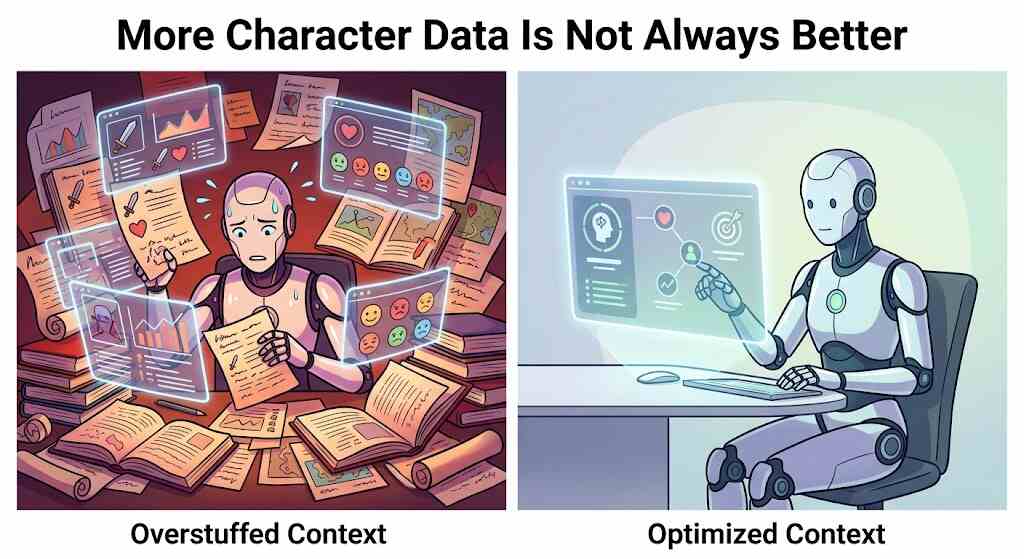
Too often, advanced users have experienced memory problems caused by an overload of Lorebook entries. According to NovelAI, adding too many Lorebook entries could affect context generation, and in reality, it may create a sense of inconsistency and erratic behavior in the character because of contradicting information.
Instead, use the following approach:
- Do not add more than 3-6 truths to the character in the Memory Box.
- Create small, concise, and independent Lorebook entries.
- Delete redundant traits that have already been mentioned somewhere else.
- Use only consistent and clear descriptions, such as “cold but warm,” “shy but dominant.”
If your custom character starts behaving unexpectedly, begin with simplification. Almost all memory problems can be solved with a simpler setting.
Watch for Cascading Activation and Accidental Cross-Talk
According to NovelAI, cascading activation is the ability to use keys within entries for searching other entries that are not story context entries. This is useful, but it could also cause unintentional cross-communication. For instance, a side character may accidentally call up another entry based on the key words you have used.
For instance, if you use the trigger Doctor, then many entries will be called up. This is because Doctor could be any doctor. Instead, use this set of key words:
- Dr. Lena Vale
- Lena Vale
- Lena
That ensures that the process is clean, reducing identity bleed among the characters.
Also Read: DeltaMath Login Guide 2026: Why Passwords Fail & How to Fix Access
A Simple Real-World Fix Workflow That Usually Works
If the memory function for a NovelAI character fails to perform satisfactorily, follow the outlined procedure below:
- Reframe the memory box using short behavioral statements.
- Reduce the size of the lorebook and make sure that each point describes one specific function only.
- Include better identifiers that are based on the real names used in the scenes.
- Remove all repetitive elements in memory, author notes, and lore.
- Make references to the character using his/her name regularly in long scenes.
A common issue in AI writing is a character performing well initially but then to become less dynamic midway through the conversation. The problem here usually relates to poor context management and not the bad character itself. The simplification of the character identity into simple active traits normally helps.
Conclusion
The best way to solve the problem of custom character memory in NovelAI is to rethink the concept of memory itself from something like an information bank to a tool used to direct behavior. Make sure your character has identity in the Memory Box, use the Lorebook to retrieve the information efficiently, keep the triggers specific, and do not overload the model with redundant information. As a result, you will end up having more stable, realistic, and functional characters.
Frequently Asked Questions
Why does a character lose their personality during the scene in NovelAI?
That happens because recently introduced parts of the narrative start overshadowing the initial set-up. This can happen if character’s main qualities are underdefined or covered by too much memory text.
Do I have to include all information about the character into the Memory Box?
No, the Memory Box is best used for general and lasting knowledge. Check the Lorebook for information that needs to be represented when the character appears.
Does case sensitivity matter for Lorebook keys?
No, according to NovelAI, Lorebook keys do not need to be exact regarding capitalization.
Can too many Lorebook entries affect the consistency?
Yes, as per NovelAI too many relatively inserted Lorebook entries may interfere with creating context. In addition to that, an excess of the injected information can disrupt the characterization of the character.
What is the fastest way to fix NovelAI character memory problems?
Redesign the character into a short list of behaviors, optimize keys, and get rid of unnecessary or contradictory notes.
