
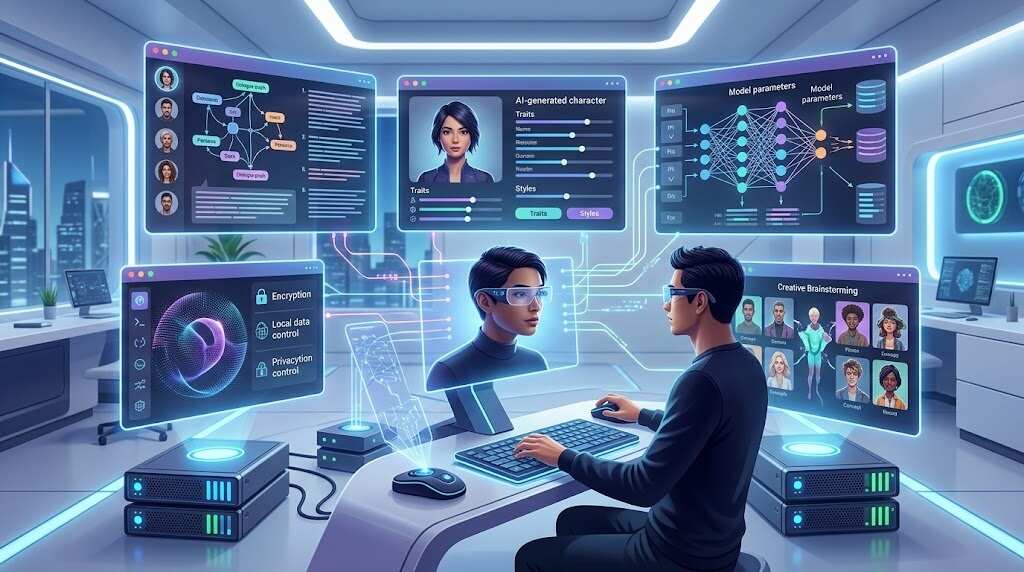
Finding alternative platforms for good character AI turns out to be quite difficult. There is a great number of lists of available solutions; however, open-source products differ a lot from commercial chatbots in terms of freedom, security and control over the characters’ behavior. However, open-source solutions require a bit more set-up, which could include things like setting up an API key, bringing in character cards, or running your own model locally.
It is exactly what makes this article so relevant. Instead of cluttering the list with low-quality or barely functional apps, this article focuses only on those open-source platforms that are recommended nowadays, in project documents and roleplay communities, and answers one key question: why would the user prefer this one. If you need AI chatbots like Character AI without restrictions of the platform itself, here are the solutions worth considering.
- Quick Comparison: Which Open-Source Option Fits You Best?
- What Makes a Good Character.ai Alternative?
- 1. SillyTavern Is the Best All-Round Choice for Serious Roleplay
- 2) RisuAI Is the Easiest Open-Source Option to Live With Day to Day
- 3) Agnai Is the Most Interesting Choice for Shared and Collaborative Use
- 4) TavernAI Still Matters Because the Ecosystem It Helped Build Still Matters
- 5) Text Generation WebUI is the Optimal Selection for Users Needing Local Model Management
- What Real Users Commonly Report Before Switching
- Final Verdict
- FAQs
Quick Comparison: Which Open-Source Option Fits You Best?
| Tool | Best for | Setup difficulty | Cost structure | What stands out |
|---|---|---|---|---|
| SillyTavern | Power Users, advanced character creation | Medium | Free frontend; charge for API or local model | Best extensions ecosystem and character controls |
| RisuAI | Mobile users, simple sign-up process | Low-to-medium | Free frontend; requires API/local backend | Better first-time experience |
| Agnai | Multi-tenant, multiple user environments | Medium | Free/self-hosted; cost of backend varies | Collaboration-friendly |
| TavernAI | Traditional Tavern-style character workflows | Medium | Free frontend; cost of backend varies | Familiar ecosystem, compatible with cards |
| text-generation-webui | Controlling local models and privacy-first settings | High | Free; local hardware or hosting of model | Full control over the model below |
What Makes a Good Character.ai Alternative?
Calling the leading alternatives to Character.ai “uncensored chat apps” is an overgeneralization. In reality, serious users value:
- Character memory and context window length
- Character card compatibility (Tavern v2 standard)
- Selection of the model
- Privacy
- Stability in long sessions
- Deep prompt tuning and generation controls
It’s important because the majority of people interested in artificial intelligence chat services like Character AI do not pursue something new just for the sake of it. They look for smooth roleplay without interruptions.
1. SillyTavern Is the Best All-Round Choice for Serious Roleplay
Currently, SillyTavern is considered the default choice of advanced users in open-source communities. It has become the go-to tool for those looking to gain full control over character behavior, memory prompts, lorebooks, regex replacement, and even extensions.
The greatest advantage of SillyTavern is that it allows you to use different models from various providers without any limitations. It is this quality that makes people bring SillyTavern up every time someone discusses best alternatives to Character AI in terms of character AI chatbots. It is especially relevant for those who write and develop storylines.
However, one must be aware of the fact that SillyTavern is not plug-and-play. One cannot expect to use SillyTavern out-of-the-box because newbies usually underestimate the configuration process. The typical scenario is that you will have to connect the tool to an API provider like OpenAI, Anthropic, OpenRouter, or any other suitable local backend. However, it is all worth it if you look for AI chatbots like Character AI but with extended controls.
2) RisuAI Is the Easiest Open-Source Option to Live With Day to Day
RisuAI stands out because it does away with the initial hassles which discourage new users. The application offers the same old-character-card workflow known to many users, but this time in a cleaner and more lightweight version.
All these qualities make the application particularly suitable for those who need alternatives to character AI and do not want to have a tiny software laboratory. If your actual requirement is “I just want to open my smartphone, jump into a roleplay session, and avoid fighting a complex UI,” RisuAI becomes the most appropriate choice.
What really matters here is the usability of the application. RisuAI can be referred to as the alternative that suits those people who enjoy the Tavern-style system but want to stay far away from any complex settings in the beginning. This quality is really important for mobile users looking for an AI chat equivalent to Character AI.
3) Agnai Is the Most Interesting Choice for Shared and Collaborative Use

Most of the character building systems available are designed for use by an individual. Agnai is unique in the way that it can be used in server-based and multi-user settings and thus is ideal for use within smaller communities, groups of friends or when someone is creating a collaborative role-playing environment.
This is how Agnai distinguishes itself from other character AI programs. The program is not just another frontend that offers character cards but is actually one of those few options that can be used in a collaborative setting.
Agnai would be a good choice to use if one wishes to have a group of characters to work with, try out various prompts with other people or have a more collaborative approach to everything. It is definitely not something that will be the first choice of a casual user but is good for other purposes.
4) TavernAI Still Matters Because the Ecosystem It Helped Build Still Matters
Although TavernAI is no longer the latest buzzword on the topic, ignoring it would be wrong since the overall culture of using character card generators that is based on Tavern-style methods continues to influence the way people change platforms.
TavernAI continues to matter for anyone who appreciates familiarity, older card banks or the more classic approach to roleplaying. In a world where new tools emerge and fade away rapidly, the very concept of compatibility has value.
For anyone evaluating their options for character-AI applications, TavernAI is not about innovation but consistency. If you have been exposed to Tavern style role-playing, you will know it.
5) Text Generation WebUI is the Optimal Selection for Users Needing Local Model Management
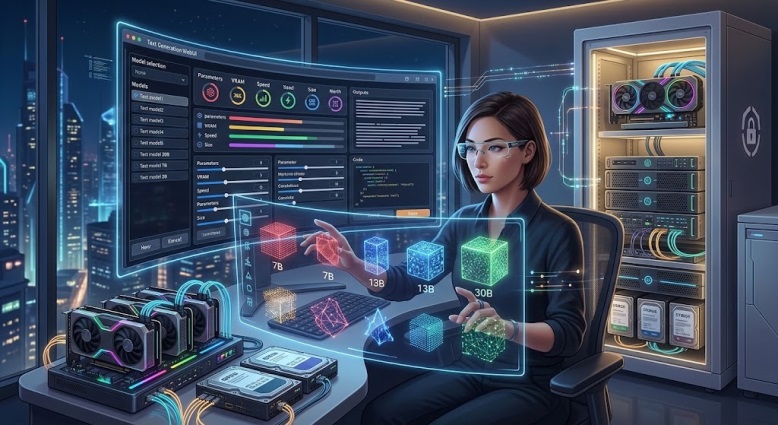
If your intention is to achieve independence, then text-generation-webui is definitely one of the options in this category. Text-generation-webui is not a character platform, but an all-in-one control panel where you can work on your models independently.
Text-generation-webui is very appealing to advanced users since it guarantees them privacy and freedom to experiment with different models and get great results using only local performance. However, there is one significant drawback of text-generation-webui – it has quite a steep learning curve. Working with large models locally needs some decent hardware, and sometimes VRAM may become a problem. Quite often, even a small model of roleplay still needs a good consumer-grade GPU.
Overall, it can be considered one of the best options if you need the maximum level of control. If your objective is not to choose an app similar to Character.ai but gain access to the whole stack of yours, then this choice will probably satisfy your needs.
What Real Users Commonly Report Before Switching
A few trends seem to emerge in community conversations:
SillyTavern is commended for its depth, though new users find it confusing.
RisuAI is commonly recommended by users looking for smoother setup.
Agnai gains traction among users who want to create shared spaces as opposed to individual chats.
Local configurations remain attractive until the time when users face limitations regarding hardware capabilities and VRAM.
This last one is particularly important. When people look for character AI alternatives, they expect open source alternatives to be drop-in replacements. But they aren’t. The good part is versatility, while the bad part is that users have to understand how frontends, APIs, prompts, and local inference work.
Final Verdict
The main advantages of the above character AI substitutes differ from one another, and there is no uniform goal among them. SillyTavern would be ideal for those who desire the maximum possible customizability for roleplay. RisuAI would appeal to users seeking the most convenient substitute. Agnai would be a rational choice in collaborative scenarios. TavernAI remains current due to familiarity with its ecosystem. And text-generation-webui is ideal for those seeking complete local control of the service, not simply a new interface.
Therefore, in looking for AI Chatbots like Character AI, the important issue is not whether they are better or not; the issue is more about the qualities that the user is interested in.
FAQs
1) Which is the best open source alternative to Character.ai?
SillyTavern tends to emerge as the best choice overall, combining the right amount of flexibility and character capabilities together with an extensive ecosystem.
2) Which is the simplest choice for beginners?
The most straightforward choice to consider if you want something simple and easier on the eye is RisuAI.
3) Are these applications available without API keys?
Some are capable of using local models but the majority of users prefer connecting their applications to an API provider. The frontend part will be free but the model use comes at a price.
4) Which of them is the most private?
Local deployment in combination with either text-generation-webui or the whole stack is your best bet when it comes to privacy.
5) Can the character cards be imported and distributed through more than one platform?
Yes, quite often. Character-card capability is one of the biggest advantages of the Tavern ecosystem.
